July was the month the 2026 TV generation finally arrived on shop floors across Europe and it ended with a verdict: Samsung’s S95H is now the QD-OLED to beat. Sony’s True RGB sets rolled out worldwide, Philips locked in the first Dolby Vision 2 Max OLED TVs and LG Display showed off a cheaper way to build an OLED panel. Here are the seven stories worth your time this month.
1. Samsung’s S95H dethrones Sony at the 2026 TV Shootout
The annual TV Shootout, hosted by US retailer Value Electronics and its founder Robert Zohn, took place on July 16, 2026, with Samsung, LG and Sony going head-to-head. Every model was benchmarked against Sony’s own BVM-HX3110 professional reference monitor and scored by a panel of judges across color accuracy, HDR performance, shadow detail, video processing and motion handling.
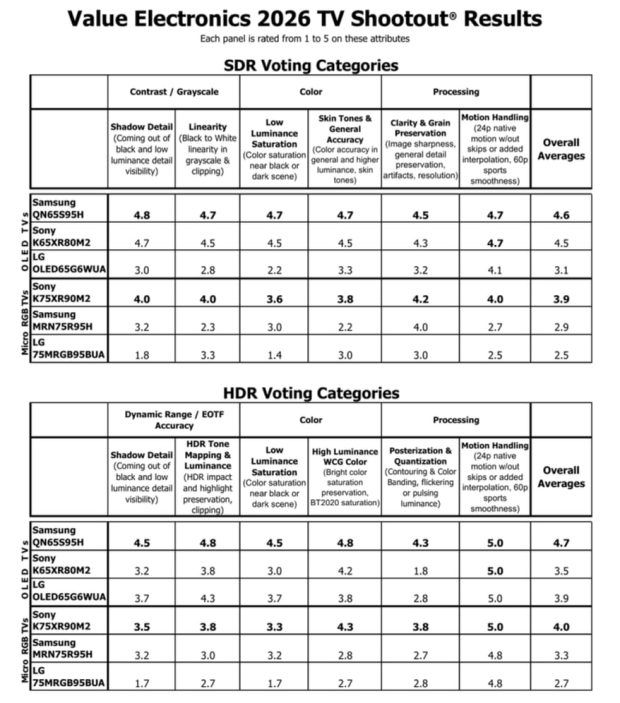
In the OLED category, Samsung’s S95H took the crown with a score of 9.3, ahead of Sony’s Bravia 8 II at 8.0 and LG’s G6 at 7.4, ending Sony’s seven-year run as reigning “King of OLED.” Sony did not leave empty-handed: its Bravia 9 II won the RGB LED LCD category with 8.1 points, beating Samsung’s R95H (6.6) and LG’s MRGB95B (5.5). If you want to see how far Samsung’s QD-OLED has come, our review of the S95D, last year’s model, is a good place to start.
Source: FlatpanelsHD: 2026 TV Shootout: Samsung crowned OLED king, Sony claims RGB LED LCD title
2. The full 2026 flagship generation is finally on shelves across Europe
After months of teasers and staggered launches, the 2026 flagships from Samsung, LG, TCL and Hisense are now sitting on shelves in the UK and across Europe. Samsung’s full OLED lineup, led by the S99H with its metal art frame and wireless One Connect box, and the S95H, went on sale globally within the same week as its rivals. LG’s G6, successor to last year’s well-reviewed G5, also started appearing in physical retail stores after a launch that had been delayed by several months.
For anyone still deciding between generations, it is worth comparing how far the picture quality has actually moved. Our LG C5 (2025) review is a useful reference point before putting money down on the G6.
Sources: HDTVTest: Samsung’s 2026 OLED TVs now on sale worldwide · HDTVTest: LG’s 2026 OLED TVs finally start appearing in retail stores
3. Sony’s True RGB TVs roll out globally
Sony’s True RGB line, the Bravia 9 II and Bravia 7 II, is now shipping worldwide. Unlike most RGB Mini-LED competitors, Sony’s backlight uses a local dimming approach derived from its own BVM-HX3110 mastering monitor, the same reference display used in Hollywood postproduction, processing the signal with 96-bit precision and distributing power to each red, green and blue channel scene by scene.
The practical upshot is that blooming around a bright red object now shows up tinted red instead of the usual white halo you get from a blue backlight. In an HDR10 test sample mastered at 4,000 nits, the True RGB set held onto nearly its full brightness, while competing RGB LED models in the same test only reached between roughly 700 and 2,200 nits. We covered the launch of this technology back in spring in our article on Sony’s True RGB announcement, and it is worth revisiting now that real units are in reviewers’ hands.
Source: HDTVTest: Sony’s 2026 True RGB TVs roll out globally
4. Philips becomes the first brand with Dolby Vision 2 Max across its whole 2026 OLED range
Philips has confirmed its full 2026 lineup, and it is the first brand to bring Dolby Vision 2 Max to OLED TVs. The flagship OLED951 and OLED911 pair a 10th-generation P5 processor with a MediaTek Pentonic 800 chip, enabling four full-bandwidth HDMI 2.1 ports, and both use an upgraded Tandem WOLED panel rated at 165Hz with a claimed 4,500 nits peak and over 400 nits full-screen brightness. Even the mid-range OLED811 gets Dolby Vision 2 Max, on a brighter OLED EX panel rated up to 2,500 nits.
With Samsung skipping Dolby Vision entirely and LG holding off on the Max tier for its 2026 models, Philips has effectively made itself the reference point for Dolby Vision 2 Max content this year, at least until the format spreads to more brands.
Source: FlatpanelsHD: Philips unveils 2026 OLED TVs with Dolby Vision 2 Max, four HDMI 2.1
5. LG Display shows a cheaper way to build an OLED panel: two stacks instead of three
At the K-Display Business Forum in South Korea, LG Display showed off a new white OLED panel built with only two emissive layers instead of the three used in its current Primary RGB Tandem panels. The company says the two-stack design reaches comparable picture quality at both 6,500K and 10,000K color temperatures, supports a wider color gamut than the existing three-stack panel, and runs at four volts lower operating voltage.
None of this changes what is on shelves today, but it points at where LG Display wants to take costs next: a panel this close in quality to the flagship Tandem stack, built with one less layer, is exactly the kind of change that eventually shows up in more affordable OLED TVs a generation or two down the line.
Source: HDTVTest: LG Display shows off new two-stack OLED panel with one less emissive layer